
How long do Saniflos last? The answer depends on how heavily the unit is used, how well it was installed, local water hardness, what is flushed through it and how well it has been looked after.
There is no fixed age at which a Saniflo automatically needs replacing.
How long does a Saniflo last?
8–10 yearsSaniflo macerators are designed to provide around 8–10 years of reliable service, although well-maintained units can last considerably longer and some remain in use for 20 years or more.
Can a Saniflo last more than 10 years?
Yes. The expected lifespan is a useful guide rather than an expiry date.
A correctly installed and well-maintained Saniflo can continue operating for many years beyond its expected lifespan. Some units continue working for more than 20 years.
The condition of the unit is generally more important than its age. If an older Saniflo develops a fault, it is often worth having the problem diagnosed before considering replacement.
What affects how long a Saniflo lasts?
What you flush through it
Saniflo macerators are designed to handle human waste and toilet paper.
Wipes, sanitary products, cotton buds and other foreign objects can cause blockages or damage internal components. Even products labelled as flushable are best kept out of a macerator.
Using the system correctly is one of the simplest ways to help extend its working life.
Limescale and hard water
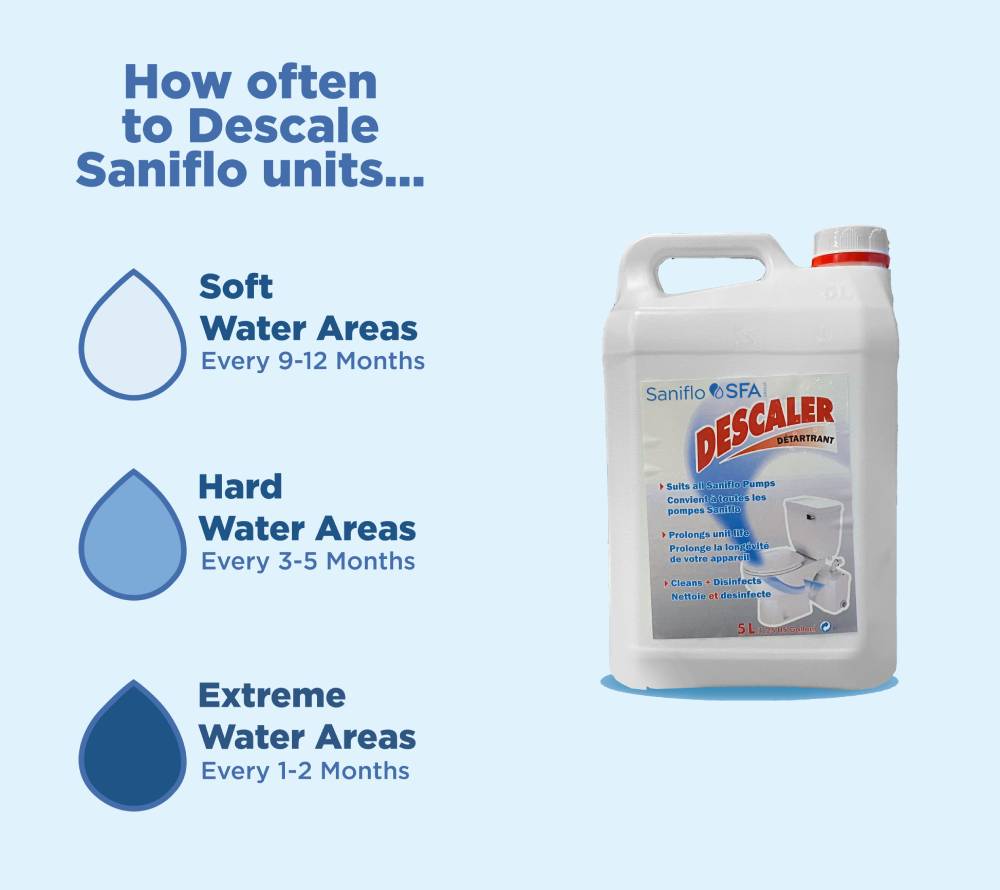
Limescale can build up inside a Saniflo, particularly in hard-water areas, and affect its internal components over time.
Regular descaling helps reduce this build-up. Saniflo recommends its Descaler every three to six months in hard-water areas. How often depends on the hardness of your local water and how heavily the unit is used.
Leaking toilets and connected appliances
Sometimes a Saniflo that is operating too frequently is not actually the source of the problem.
A leaking toilet cistern, dripping tap or another connected appliance can continually allow water into the macerator. This causes the Saniflo to activate when it isn’t needed.
If your Saniflo has started running when nobody is using the bathroom, the connected toilet and other appliances are worth checking as well as the macerator itself.
Installation quality
Correct installation has a major effect on how reliably a Saniflo operates.
Problems with discharge pipework, incorrect gradients or other installation issues can contribute to blockages, excessive noise and repeated faults.
If the same problem keeps returning after repairs, the cause may be the installation rather than the Saniflo itself.
Does a 10-year-old Saniflo need replacing?
Not necessarily.A Saniflo reaching 10 years old does not automatically mean it needs replacing. At that age, however, the condition of the unit, the fault, repair history and availability of replacement parts become increasingly important.
Some older Saniflos can still be repaired economically, while others may be better replaced if repairs are becoming frequent or the cost of keeping the unit going no longer makes sense.
How do you know when a Saniflo needs attention?
Changes in the way your Saniflo operates are more useful than its age alone.
Signs worth investigating include:
- unusual or increasingly loud noises
- the motor running for longer than normal
- the Saniflo activating unexpectedly
- slow drainage
- water backing up
- leaks around the unit
- waste not being discharged properly
- repeated faults
None of these automatically means that the complete Saniflo needs replacing.
Use our Saniflo troubleshooting guide
Repair or replace an older Saniflo?
Age alone isn’t a good reason to replace a Saniflo. The fault, overall condition of the unit and cost of repair are usually more important.
- The fault is straightforward
- The unit is otherwise in good condition
- Genuine replacement parts are available
- The repair cost is reasonable
- It hasn't suffered repeated major faults
- The repair is uneconomical
- Important parts are no longer available
- Several components are deteriorating
- The same major faults keep returning
- The existing unit is unsuitable for the application
How can you make a Saniflo last longer?
The basics make the biggest difference:
- Descale it regularly – particularly in hard-water areas.
- Only flush appropriate waste – keep wipes and foreign objects out.
- Deal with leaks promptly – especially toilets or taps connected to the macerator.
- Don’t ignore changes in operation – unusual noises or running behaviour are worth investigating.
- Correct installation problems – particularly where the same fault keeps returning.
- Have faults properly diagnosed – an older unit doesn’t automatically need replacing.
So, how long do Saniflos last in practice? Around 8–10 years is a useful expected lifespan, but many continue working considerably longer when correctly installed and maintained.
Not sure whether your Saniflo is worth repairing?
Pumpmaster has specialised in Saniflo servicing and repairs since 1989. Our Saniflo approved engineers can diagnose the fault, repair the unit where practical and advise when replacement makes more sense.